In multi-task manipulation, a policy has to commit to the action mode that matches the current instruction. Pick the wrong mode and the robot does the wrong task. VQActFlow tokenizes action chunks into a discrete codebook and generates the codes with Variational Flow Matching, so it carries a distribution over action modes through every step of generation. At inference time, classifier-free guidance and a learned codebook critic reshape that distribution. Neither one retrains the policy.
How VQActFlow represents and steers actions
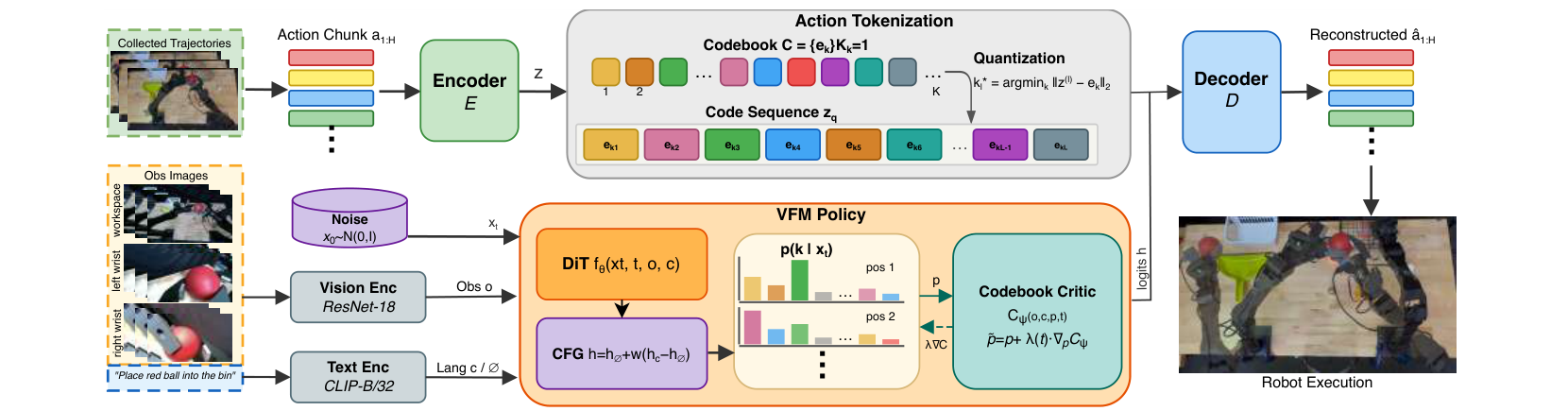
Most flow-matching policies work in a continuous space with no explicit notion of action mode, so guidance can only reshape a single continuous distribution. VQActFlow instead carries a discrete distribution over action modes through generation, which gives guidance a categorical target to act on from the first step to the last.
-
1
CFG on language conditioning. At every step it extrapolates between the conditional and unconditional logits, which sharpens how firmly the policy commits to the instructed task.
-
2
A learned codebook critic. A small transformer, trained contrastively, scores how feasible each code is and pushes the distribution toward feasible modes.
Both operate on the same categorical distribution, so you can apply them together, and neither one needs extra training.
A G1 humanoid, a bimanual platform, and LIBERO in simulation
Across all three platforms, VQActFlow beats both continuous and discrete baselines trained on the same encoder, data, and step budget.
Humanoid whole-body manipulation
A Unitree G1 with two dexterous hands runs four pick-and-place tasks in one shared workspace; only the target object and the instruction change.
| CFG weight | Success | Missed grasp | Wrong task |
|---|---|---|---|
| w=1 | 23.8 | 35.0 | 41.3 |
| w=6 | 57.5 | 40.0 | 2.5 |
Almost all of CFG's gain here comes from fixing wrong-task errors, which fall from 41.3% to 2.5%. It helps the policy choose the right task; it does not make the motion itself any cleaner.
Bimanual manipulation
Two ALOHA-style arms on four contact-rich tasks, three of them needing coordinated bimanual use.
| Method | Battery | Duck | Cylinder | Ball | Avg. |
|---|---|---|---|---|---|
| Discrete Policy, w=1.0 | 35.0 | 70.0 | 15.0 | 75.0 | 48.8 |
| Discrete Policy, w=4.0 | 65.0 | 70.0 | 35.0 | 75.0 | 61.3 |
| VQActFlow, w=1.0, λ=0.0 | 40.0 | 70.0 | 15.0 | 55.0 | 45.0 |
| VQActFlow, w=1.0, λ=1.0 | 50.0 | 75.0 | 50.0 | 65.0 | 60.0 |
| VQActFlow, w=4.0, λ=0.0 | 70.0 | 85.0 | 55.0 | 85.0 | 73.8 |
| VQActFlow, w=4.0, λ=1.0 | 70.0 | 90.0 | 65.0 | 85.0 | 77.5 |
With the same backbone, a continuous flow-matching baseline fails all four tasks. Its joints oscillate violently, roughly two orders of magnitude rougher than VQActFlow.
| Configuration | Unguided | CFG | Critic | CFG + critic |
|---|---|---|---|---|
| Inference time | 155.2 | 288.9 | 216.7 | 350.2 |
350 ms fits comfortably inside the 1.28 s budget per action chunk, and asynchronous inference computes the next chunk while the current one runs.
CFG on LIBERO-Goal
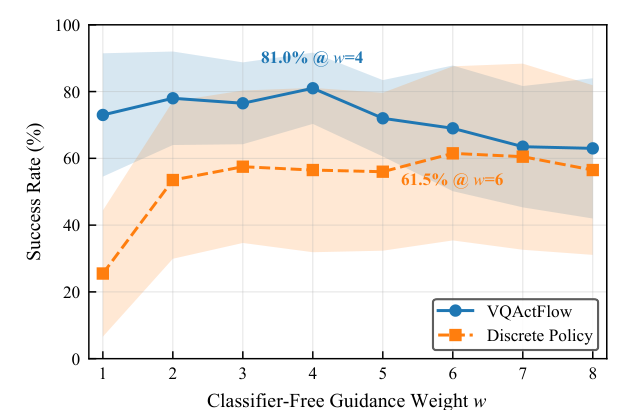
Guiding the discrete distribution directly works better than guiding a continuous approximation of it.
Multi-task scaling on LIBERO-90
At this scale, CFG and the codebook critic each contribute their own gains, and the gains mostly stack.
| Method | Type | CFG w | Critic λ | Success |
|---|---|---|---|---|
| MT-ACT | Continuous | – | – | 72.4 |
| CFM | Continuous | – | – | 77.2 |
| VQ-BeT | VQ-based | – | – | 24.1 |
| Discrete Policy | VQ-based | 1.0 | – | 49.4 |
| Discrete Policy | VQ-based | 2.0 | – | 60.3 |
| VQActFlow | VQ-based | 1.0 | 0.0 | 72.3 |
| VQActFlow | VQ-based | 1.0 | 1.0 | 74.3 |
| VQActFlow | VQ-based | 2.0 | 0.0 | 77.6 |
| VQActFlow | VQ-based | 2.0 | 1.0 | 80.5 |
| Codebook size | 128 | 256 | 512 | 1024 |
|---|---|---|---|---|
| Success rate | 62.6 | 65.6 | 72.3 | 70.1 |
Success peaks at K=512. Smaller codebooks limit how finely actions can be quantized; larger ones blow up the per-position classification space and make the categorical prediction harder to learn.
BibTeX
@article{anonymous2026vqactflow,
  title={VQActFlow: Vector-Quantized Action Mode Steering for Multi-Task Robot Manipulation},
  author={Anonymous Author(s)},
  journal={Under review},
  year={2026}
}